
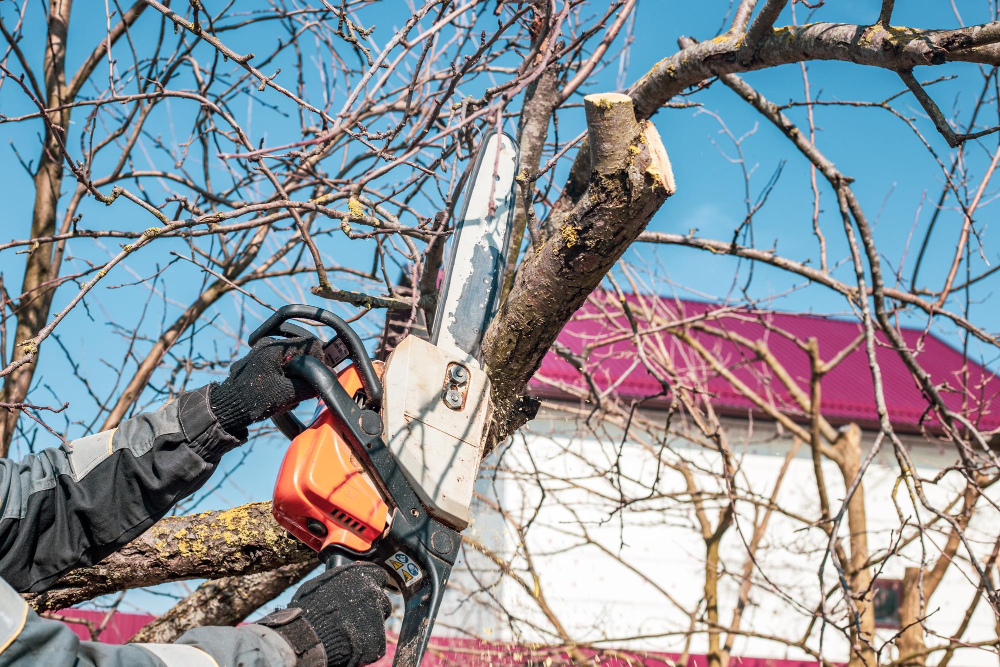
There is a hard moment in every Fairhope homeowner’s relationship with a mature tree, where the conversation shifts from how to keep the tree alive to if the tree should still be standing. It usually comes after years of pruning, sometimes after a cabling job, often after a storm reveals damage that was not visible before.
Some trees can be saved. Some cannot. The difference matters, and accepting it is part of taking care of the property responsibly.
What Cabling & Pruning Actually Do
Before getting into when these methods stop working, it helps to understand what they actually accomplish.
How Cabling Works
Cabling installs steel or synthetic cables high in the canopy to support weak branch unions or codominant stems. The cable does not heal the union. It holds the two parts of the tree together so that wind loading, ice accumulation, or weight distribution does not cause them to split apart.
For a tree with a structural weakness but otherwise solid health, cabling can extend the safe life of the tree by decades. Live oaks especially respond well to cabling, and cabled live oaks across the South have remained standing for fifty or more years after the work was done.
How Pruning Helps
Pruning addresses problems that can be cut out. Dead branches, broken limbs, weak unions on smaller branches, and overgrown sections that are loading the tree improperly. Done correctly, pruning improves the structure and reduces the wind sail effect that contributes to storm failures.
Both methods work when the underlying tree is fundamentally sound. Both methods fail when the underlying tree is not.
When Cabling & Pruning Stop Being Enough
There are specific situations where neither approach can save the tree, and recognizing them early avoids spending money on work that does not solve the problem.
Advanced Internal Decay
A live oak that looks healthy on the outside can be hollow on the inside. Once internal decay reaches a certain percentage of the trunk cross-section, the tree no longer has the structural integrity to remain standing safely, regardless of what is done to the canopy.
Pruning removes weight from above, which helps slightly, but it does not restore the strength of the trunk. Cabling holds the upper canopy together, but the failure point on a hollow tree is the trunk itself, below where any cable could be installed. When testing shows that less than thirty percent of the trunk is sound wood, the tree generally needs to come out.
Root System Failure
Roots are not visible, which makes root failure one of the most under-diagnosed problems in residential trees. A tree with significant root decay, root damage from construction, or root system loss from soil compaction is no longer stably anchored.
There is no pruning or cabling solution for root failure. The tree has lost its connection to the ground, and nothing done above ground addresses that. Trees with confirmed root failure are removal candidates regardless of how the canopy looks.
Multiple Compounding Issues
Sometimes a tree has manageable issues individually, but the combination puts it past saving. Internal decay, plus a structural lean, plus deadwood throughout the canopy, plus root flare problems, adds up to a tree that cannot be safely maintained even with significant intervention.
A trained eye looks at the full picture rather than fixing individual issues in isolation. When the issues compound, the responsible answer is removal, not a series of expensive repairs that do not actually make the tree safe.
Severe Storm Damage to the Main Structure
A tree that has lost a major scaffold limb, split at the trunk, or sustained other damage to its primary structure during a storm is often past saving even if it is still standing. Pruning can clean up the damage. Cabling can hold what is left together. But the original structural integrity is gone, and the tree is no longer the same tree it was before the storm.
For these situations, the question is if continuing to maintain a compromised tree makes sense versus removing it and starting fresh with something appropriate for the property.
Why Holding On Too Long Costs More
The temptation to keep trying is understandable. Mature trees take decades to grow, and watching one come down feels like a loss. But holding on past the point where the tree can be safely maintained creates problems that get worse over time.
A declining tree near a house becomes more dangerous every year. The cost of removal goes up as the tree becomes more compromised, because it requires more careful dismantling and often a crane that would not have been needed earlier. And if the tree fails on its own before removal happens, the cleanup, repair, and insurance cost dwarfs what proactive removal would have been.
Knowing when a tree has reached the end of its useful life on a property is one of the harder calls in tree care. It requires honesty about the condition of the tree, willingness to act on what an evaluation reveals, and acceptance that some trees cannot be kept indefinitely. Fairhope homeowners with mature trees on the property face this decision sooner or later, and getting the call right is part of taking care of the place.