
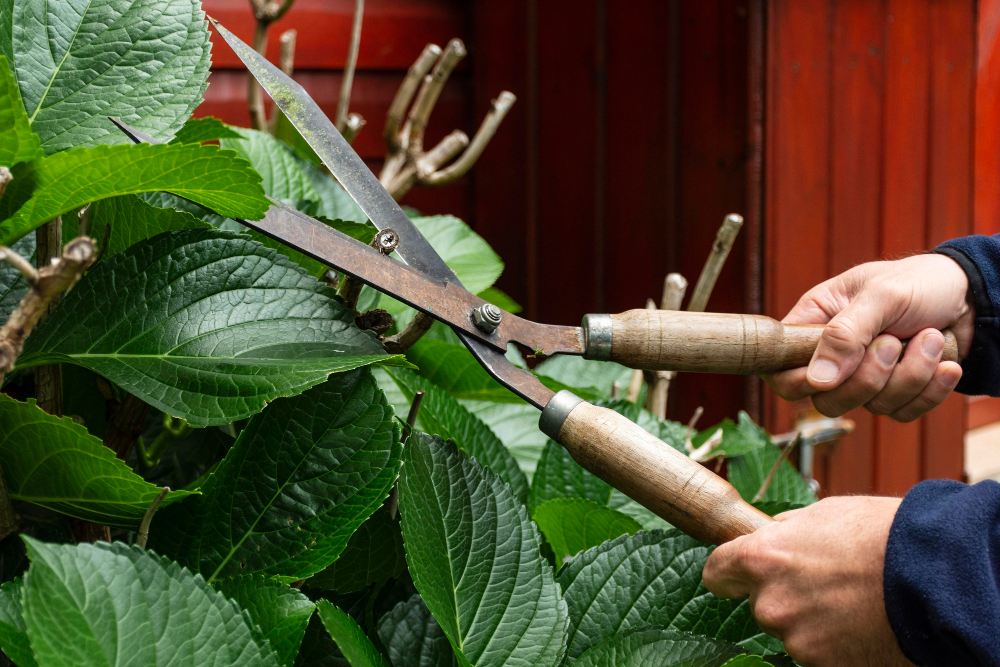
Pruning a tree looks like one of those tasks anybody can handle. Pick up a saw, cut off the parts that are in the way, and the tree looks better. The problem is that pruning is one of the few maintenance activities where doing it wrong can actually kill a tree that was completely healthy before someone touched it.
In Daphne, where most residential properties have at least a few mature trees, this matters more than people realize. The tree that came down five years after a bad pruning job did not just happen to fail. The pruning is what failed it.
How a Pruning Cut Is Supposed to Work
A tree heals from a pruning cut by sealing off the wound. It does not regenerate the cut tissue. Instead, the tree grows woundwood around the edge of the cut, eventually closing it off and isolating the wound from the rest of the tree.
This process only works correctly when the cut is made in the right place.
The Branch Collar
Every branch on a tree has a slight swelling where it joins the trunk or a larger branch. This swelling is called the branch collar, and it contains specialized cells that the tree uses to seal off pruning wounds. When a cut is made just outside the branch collar, leaving the collar intact, the tree can close the wound efficiently and cleanly.
The collar is not always obvious to the eye. On some trees it is a clear ring of raised bark. On others it is subtle and only visible to someone who has been trained to spot it.
Why the Collar Matters
When the cut is made too far out from the trunk, leaving a stub of branch sticking out, the stub dies and rots. Decay travels back through the dead tissue and eventually reaches the trunk, opening up an entry point for fungal infection.
When the cut is made too close, removing the branch collar entirely with a flush cut, the tree loses the cells it needs to seal the wound. The cut stays open longer, and decay fungi enter through the exposed area.
Both scenarios produce the same end result. The tree gets infected at the cut site, decay spreads inward, and the structural integrity of the tree starts to degrade from the wound outward. Years later, the tree fails or starts dying back, and nobody connects it to the pruning that happened a decade earlier.
The Cuts That Cause the Most Damage
Some pruning practices are particularly destructive, and they are common enough that most Daphne homeowners have seen them done on someone’s tree, if not their own.
Topping
Topping is the practice of cutting the top of a tree off at an arbitrary height, usually because someone thought the tree was getting too tall. It is one of the most damaging things that can be done to a tree.
Topping removes most of the leaf-bearing canopy, which the tree needs to produce food. The tree responds by sending out fast-growing weak shoots from the cut points, called water sprouts, that have poor structural attachment. The cuts themselves are usually too large to seal, so decay enters and spreads through the trunk.
A topped tree is on a path to decline. It might survive for years, but it is not the same tree, and the failure point has been built in.
Lion-Tailing
Lion-tailing is when most of the inner branches of a tree are removed, leaving foliage only at the ends of the main branches. The tree ends up looking like a series of long bare branches with tufts of leaves at the tips.
This shifts all the weight to the ends of the limbs, which dramatically increases the risk of branch failure during storms. It also exposes the inner bark to sunburn, removes the structural taper of the branches, and stresses the tree by removing too much foliage at once. Lion-tailed trees are common storm failures.
Flush Cuts
Flush cuts remove the branch collar entirely, leaving a smooth trunk where the branch used to be. The tree cannot seal the wound properly, decay enters, and the trunk develops a column of internal rot extending up and down from the cut site.
A tree with multiple flush cuts down its trunk is a tree with multiple internal rot columns. The structural integrity drops over time, and the tree eventually fails or has to come out.
Stub Cuts
The opposite problem. The branch is cut several inches out from the collar, leaving a dead stub. The stub does not heal because it is no longer attached to living tissue. It rots, the rot reaches the trunk, and the same decay process starts.
What Proper Pruning Looks Like in Daphne
Correct pruning is species-specific, season-specific, and goal-specific. A live oak in Daphne should be pruned in the dormant months to avoid oak wilt risk. A water oak should be structurally pruned while it is young to correct codominant stems before they become a failure point. A pine should not be heavily reduced because it does not recover well.
The cuts should be made just outside the branch collar, sized appropriately for what the tree can heal, and limited in total volume so that no more than twenty to twenty-five percent of the live canopy comes off in a single season.
Pruning that follows these rules produces healthier trees, fewer storm failures, and longer life spans. Pruning does not produce the trees that come down ten years later for reasons nobody could quite explain at the time.