
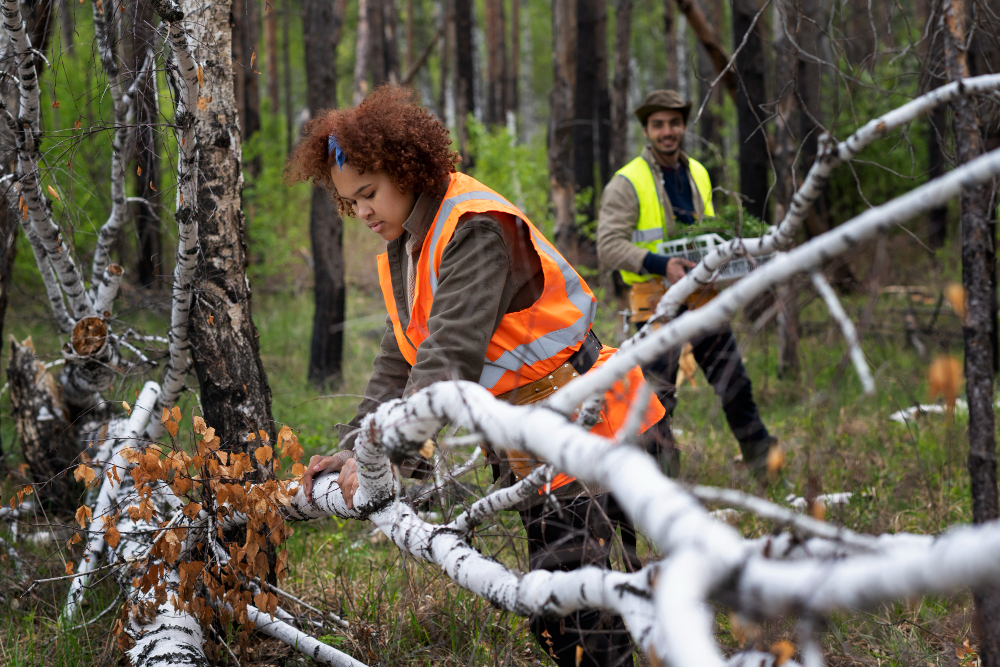
Storms in Baldwin County move fast. One hour you’ve got heavy rain bands rolling in off Mobile Bay, and the next you’re looking at a downed pine across your driveway or a large limb pressed against your roof. If you’re dealing with tree damage in Daphne right now, the first 24 hours matter more than most people realize.
This is a practical guide to what you should do and what you should avoid right after a storm hits.
Stay Back & Assess From a Safe Distance
The first instinct after seeing a fallen tree is to go outside and get a closer look. That’s understandable, but it can get you hurt. Downed trees often bring power lines with them, and a line lying on the ground or draped across a trunk is still energized until the utility company says otherwise.
Before stepping outside, check for downed lines near or on the tree. If you see any, stay inside and call Alabama Power. Do not go near the area until a utility crew clears it. That single step prevents more storm-related injuries than most people realize.
Once you’ve confirmed there are no downed lines, do a visual check from a safe distance. You’re looking at three things:
- If the tree is resting against your home or another structure
- If the root ball has lifted out of the ground
- If large limbs are suspended overhead in surrounding trees (these are called widow makers, and they fall without warning)
You’re not trying to fix anything at this stage. You’re just getting a read on the situation.
Don’t Take a Chainsaw to It Yourself
After a storm, it’s common to see homeowners outside with chainsaws working to clear trees on their own. For a small limb sitting in the grass, that might be fine. But anything involving a leaning trunk, a tree resting on a structure, or a root ball that has shifted out of the ground is a different situation entirely.
Why Storm Tree Work Is Dangerous Without Training
Trees under tension behave in ways that aren’t obvious until it’s too late. A trunk that looks stable may be loaded with stored energy from the angle it fell. When you cut into it without knowing how to read that tension, logs can kick back hard and fast.
Emergency tree removal in Daphne, AL gets called out constantly after storms, and a large portion of that work comes from homeowners who started a job and then realized they were not equipped to finish it. Get a professional crew on the phone before you touch anything structural.
Document Everything Before Cleanup Begins
Before any work starts, take photos and video of the full damage area. Walk around the tree and shoot it from multiple angles. Get shots of where it’s resting, what it’s touching, and any visible damage to the roof, siding, fencing, or yard.
Your insurance company is going to want documentation, and the more thorough you are before cleanup begins, the smoother the claims process will go. Most homeowner policies cover tree removal when a tree has fallen on a structure, though coverage details vary, so call your provider early.
What to Have Ready When You Call Your Insurer
Have your policy number, the date and time of the storm, a description of what fell and where it landed, and your photos ready when you call in the claim. Ask specifically about debris removal coverage, because some policies treat that separately from structural repair.
Get a Licensed Crew Out for Emergency Tree Removal in Daphne, AL
Once you’ve documented the damage, it’s time to call for help. Emergency tree removal in Daphne, AL is available through licensed, insured tree services that work after storm events. When you call, give them the specifics: the size of the tree, if it’s on a structure, if there are power lines involved, and if there are access limitations on your property.
A legitimate crew will come out for an on-site assessment before they quote the work. Be careful of anyone who gives you a price over the phone without seeing the job. Storm damage varies too much for a blind quote to be worth anything.
What to Look for in an Emergency Tree Crew
Ask for proof of insurance before anyone touches your property. If a crew is working uninsured and something goes wrong, the liability falls on you. Also ask about their equipment. Larger storm removals often require a crane or bucket truck, and a crew that only has hand tools may not be able to do the job safely.
After major storms, tree crews book up quickly. Call early and get on a schedule even if they can’t come the same day.
Keep Everyone Away From the Damage Area Until Work Is Done
While you’re waiting for the crew to arrive, keep family and pets out of the affected area. If the tree is on your roof, avoid spending time in the rooms directly below the impact point. A tree resting on a structure applies continuous pressure, and that load can shift without notice.
If you have a tarp and the roof has been breached, you can cover the affected area to limit water intrusion while you wait. Only do this if you’ve confirmed the tree is stable and there are no hazards overhead.
Don’t Forget About the Trees Still Standing
After a storm, attention naturally goes to whatever fell. But some of the most dangerous situations involve trees that are still upright with compromised root systems or split trunks that weren’t obvious before the storm. Trees that were already leaning or showing signs of decay are especially worth checking after heavy winds.
If anything looks off, get an arborist out to evaluate before the next storm comes through. Baldwin County’s storm season is not a one-and-done event. A tree that survived this one in a weakened condition may not survive the next.
The first 24 hours after storm damage come down to three things: safety, documentation, and getting the right people on the job. Skip any of those steps and a manageable situation can get much worse.