
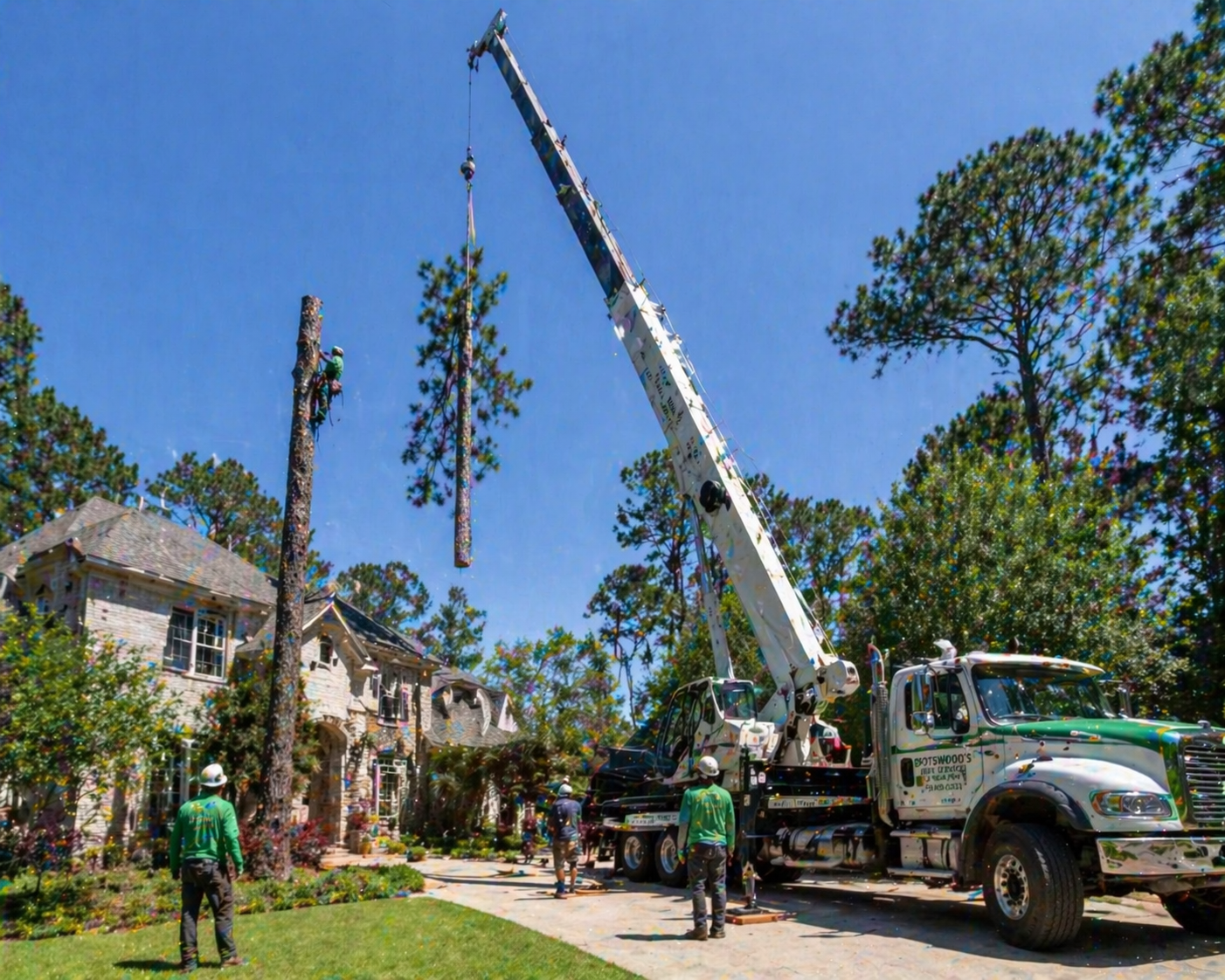
Not every tree removal in Daphne needs a crane. Most residential jobs are handled with climbing crews, rope rigging, and bucket trucks. But there are specific situations where a crane is not just the better option, it is the only safe option. A mature live oak leaning over a house, a storm-split pine wedged between two structures, or a dead hardwood on a lot with no open drop zone are jobs where conventional methods introduce real risk of property damage and injury.
This guide explains when crane tree removal is genuinely needed in Daphne, how the process works, what drives the cost, and how to know if the company you are hiring can actually handle it.
What Crane Tree Removal Actually Is
Crane tree removal uses a hydraulic boom crane to lift and control each section of a tree as it is cut, rather than lowering it piece by piece on ropes or letting it fall. A certified climber or aerial lift operator attaches rigging near the top of the tree, the crane takes tension on the line before the saw cuts, and the section is lifted cleanly up and away from whatever is below it, then placed in a designated drop zone for processing.
The key difference from conventional removal is control. With rope rigging, each cut section drops and swings under gravity within a calculated arc. With a crane, the section is under positive control from the moment the chainsaw enters the wood. That distinction is what makes crane work the safer method for specific types of removals, even though it is more expensive and requires more setup.
When a Crane Is Actually Needed in Daphne
A qualified tree service will not recommend crane work when it is not required. Crane rental and setup adds significantly to the job cost, and for straightforward removals it is overkill. The situations where a crane genuinely becomes necessary fall into a few clear categories:
Trees Too Close to Structures
When a large tree is within falling distance of a house, garage, detached structure, pool, or fence, the margin for error on conventional rigging shrinks. Live oaks, mature pecans, and tall pines along Daphne’s older streets often grew up right next to homes, and a rigging mistake can put several hundred pounds of wood through a roof. A crane removes that risk by lifting each section over the obstacle instead of trying to lower it past one.
Structurally Compromised Trees
Dead, diseased, or storm-damaged trees cannot be safely climbed. The wood may look solid from the ground but is unreliable under a climber’s weight or rigging loads. Southern pine beetle kill, root rot on waterfront properties, and hurricane-split trunks all create conditions where sending a person up the tree is dangerous. Crane work with a grapple saw or crane-supported climbing keeps the crew out of harm’s way on unstable wood.
Tight Lots With No Drop Zone
Daphne has a mix of older subdivisions with tighter lots, newer developments with larger yards, and commercial properties that occupy most of their parcels. When there is not enough open ground to safely drop a 40-foot section of trunk, conventional removal has nowhere to go. A crane lifts the section up and over whatever is in the way, to a staging area on the street, driveway, or an open section of the property.
Trees Near Power Lines
A tree too close to a power line is a coordination job with Alabama Power first, but once the utility has de-energized and secured the area, crane removal is often the safest way to proceed. Lifting sections directly away from the line eliminates the risk of a falling limb making contact as it drops.
Very Large Trees
Trees over about 80 feet tall, or with trunk diameters over 36 inches, are commonly crane jobs. The sheer weight of upper sections makes them difficult to control with rope rigging, and the time required to section them down conventionally often exceeds what a crane can do in a fraction of the time.
How a Crane Removal Day Actually Goes in Daphne
For Daphne homeowners who have never seen a crane removal, the scale of the operation is usually larger than expected. Here is how a typical day unfolds:
Pre-Job Planning
Before the crane ever arrives, a certified arborist evaluates the tree, the surrounding structures, soil conditions, and access points. A lift plan maps out where the crane sets up, where outriggers go, where each section is cut and lifted, and where the processing zone will be. Good planning is what separates an efficient crane job from one that runs into problems mid-day.
Crane Positioning and Setup
The crane is driven in and positioned, often on the street or driveway depending on the tree’s location. Outriggers are deployed to stabilize the crane on the ground, which is where Daphne’s soft Baldwin County soil sometimes becomes a factor. After heavy rain, extra cribbing (wood mats under the outrigger pads) may be needed to prevent settling. A safety perimeter is established and the crew runs through a pre-lift briefing.
Rigging and Cutting
A climber ascends the tree or is lifted by the crane in a man basket. Rigging slings are attached near the top of the first section. The crane takes tension. The climber makes the cut. The crane lifts the section away, swinging it over any obstacles to the drop zone, where the ground crew receives it, chips branches, and processes logs. Then the next section. This repeats from the top down until only the stump remains.
Processing and Cleanup
Ground crew chips smaller material and cuts larger logs to size for hauling. Stump grinding, if included, happens after the crane work is complete. A full cleanup leaves the property as clean as possible, though crane jobs on large trees do produce significant debris volume.
What Crane Removal Costs in Daphne
Crane tree removal is more expensive than conventional removal because the equipment, operator, and crew size all scale up. For Daphne and Baldwin County jobs, here is a realistic cost framework:
- Standard conventional large tree removal: $800 to $2,500 for most residential jobs
- Crane-assisted removal for moderate-complexity jobs: $1,500 to $4,000
- Complex crane jobs on very large trees, difficult access, or hazardous conditions: $4,000 to $8,000 or more
- Emergency crane work after storm damage: premium pricing given availability constraints
The cost difference versus conventional removal looks significant, but for jobs where a crane is actually needed, the alternative is either not doing the work safely or risking property damage that exceeds the crane premium many times over. Insurance claims from a dropped section going through a roof often run $15,000 to $40,000 in structural repair alone. The crane fee is cheap by comparison when the risk is real.
What to Ask Before Hiring a Crane Tree Service
Not every tree service that advertises crane work actually operates its own equipment or has experience running it. Some subcontract to a crane rental company and add it to jobs they are not properly trained to execute. Before signing a contract, ask:
- Does your company own the crane, or is it subcontracted? Owned equipment usually means experienced operators and better coordination
- What is the crane operator’s certification and experience with tree work specifically?
- Are ISA-certified arborists involved in the lift planning?
- What is the general liability insurance limit? Crane tree work should carry at least $1 million in coverage, often more
- What is the drop zone plan for my specific property?
- What OSHA and ANSI Z133 safety protocols are followed on the job?
If the answers are vague or the contractor cannot provide documentation, that is a signal. Crane work is too serious to hire based on the lowest number.
Daphne-Specific Factors That Affect Crane Removal
A few things about Daphne specifically shape how crane jobs play out:
Soil and Weather Conditions
Baldwin County red clay and sandy soils behave differently when wet. After heavy rain, soft ground can compromise crane stability if outriggers are not properly supported. Reputable crews wait for conditions to dry out or bring extra cribbing rather than pushing through on saturated ground.
Setback and Access
Many Daphne properties have long driveways, fenced yards, or landscaping that limits where a crane can set up. The longer the crane’s reach has to be from its position to the tree, the larger the crane required. Spotting the crane correctly the first time is what keeps the job efficient.
Permit and Right-of-Way Issues
If the crane will be positioned in the public right-of-way or blocking a roadway, coordination with Daphne Public Works may be required. Ordinance 2011-54 and related right-of-way rules apply to temporary equipment staging. For most residential driveway setups, this is not an issue, but larger jobs on busy streets need to be planned ahead.
The Bottom Line
Crane tree removal in Daphne is the right call when the tree is too big, too dangerous, too close to a structure, or in a location where conventional methods cannot work safely. It is not the right call for routine removals where rope rigging handles the job well. A qualified tree service knows the difference and recommends the method that matches the actual conditions.
When the situation does call for a crane, the value is in the control. Each cut stays in full equipment control from the moment the saw starts until the section is on the ground in the drop zone. That control is what protects the home, the crew, and everything on the property while the work gets done.