
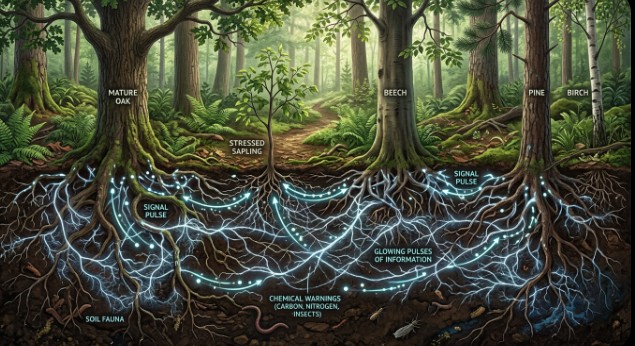
Short Answer: Do trees communicate with each other?
Yes, trees do communicate with each other through a combination of underground fungal networks and airborne chemical signals. This communication is not “speech” like humans use, but a complex biological system that allows trees to share nutrients, send distress signals, and even warn nearby trees of threats such as insects or drought.
One of the most widely discussed mechanisms is the “Wood Wide Web,” a nickname for underground mycorrhizal fungal networks that connect tree roots. Through these networks, trees can exchange carbon, water, and chemical signals, creating a living, interconnected forest system that functions much like a natural support network. Even industry professionals such as Spots Woods Tree Service often reference this phenomenon when explaining how deeply interconnected and responsive forest ecosystems really are.
Do trees communicate with each other? (Core Scientific Explanation)
Understanding how trees interact requires looking at forest ecosystems as highly coordinated biological systems rather than isolated organisms. Tree communication happens through two primary pathways: underground root-fungi networks and above-ground airborne chemical signaling.
These systems allow trees to respond to environmental stress, support neighboring plants, and improve the survival chances of the entire forest community. Rather than acting independently, trees function as part of a cooperative ecosystem shaped by millions of years of evolution.
Do trees communicate with each other? The science behind forest communication networks
One of the most important discoveries in modern ecology is the role of mycorrhizal fungi in tree communication. These fungi form symbiotic relationships with tree roots, connecting multiple trees through a vast underground network.
Through this network:
- Trees exchange nutrients such as carbon, nitrogen, and phosphorus
- Older, larger trees often transfer resources to younger seedlings
- Warning signals about drought, disease, or insect attacks spread rapidly across connected trees
This system is sometimes called the “Wood Wide Web,” emphasizing how deeply interconnected forest ecosystems are. While fungi benefit from sugars produced by trees, trees gain access to water and nutrients beyond their own root reach, creating a mutually beneficial survival system.
Above-ground Communication: Chemical Signals in the Air
Trees also communicate above ground using volatile organic compounds (VOCs). When a tree is attacked by insects or stressed by environmental conditions, it releases these airborne chemicals into the surrounding air.
Nearby trees detect these signals and respond by:
- Producing defensive chemicals that make leaves less palatable to insects
- Strengthening cell walls to resist damage
- Adjusting growth patterns to conserve energy
For example, some acacia trees are known to release warning gases that trigger nearby trees to increase tannin production, making their leaves toxic to herbivores.
How Trees Communicate: Step-by-Step Guide
Tree communication follows a structured biological process that can be broken down into five key stages:
Step 1: Detection of stress or threat
A tree detects environmental stress such as:
- Insect infestation
- Fungal infection
- Drought conditions
- Physical damage from wind or animals
Step 2: Signal production
Once stress is detected, the tree produces signals in two main forms:
- Chemical compounds released into the air
- Root-based biochemical signals sent into fungal networks
Step 3: Signal transmission through networks
These signals travel through:
- Mycorrhizal fungal connections underground
- Air currents carrying volatile organic compounds
Step 4: Response from nearby trees
Receiving trees interpret the signals and respond by:
- Activating defense genes
- Producing protective chemicals
- Adjusting water and nutrient usage
Step 5: Ecosystem-wide adaptation
Over time, these responses lead to:
- Increased forest resilience
- Shared resource distribution
- Improved survival rates for seedlings and mature trees
Types of Tree Communication (Comparison Table Section)
Tree communication occurs through multiple systems that operate at different speeds and mechanisms.
Underground vs Above-ground Communication Systems
| Type of Communication | Mechanism | Purpose | Speed | Examples |
|---|---|---|---|---|
| Mycorrhizal Networks | Fungal root connections | Nutrient sharing, warning signals | Moderate | “Mother trees” sharing carbon with seedlings |
| Chemical Signaling | Airborne VOCs | Pest defense, stress alerts | Fast | Trees warning neighbors of insect attacks |
| Root-to-root contact | Direct root interaction | Local resource transfer | Slow | Seedling support in dense forests |
| Electrical signaling (emerging research) | Internal bioelectric impulses | Stress coordination | Unknown | Early-stage scientific findings |
Sub-questions people also ask about tree communication
Do trees communicate with each other through roots?
Yes, trees exchange nutrients and signals through underground fungal networks connected to their roots.
Can trees warn each other about danger?
Yes, trees can send chemical and fungal signals that alert nearby trees to insect attacks or environmental stress.
What is the “Wood Wide Web” in forests?
It is the nickname for underground fungal networks that connect trees and allow resource and information exchange.
Do older trees help younger trees survive?
Yes, older trees often act as nutrient hubs, sharing carbon and nutrients with younger seedlings.
Are trees intelligent in how they communicate?
Trees do not have brains, but they exhibit adaptive biological responses that can appear intelligent.
Do all forests use tree communication systems?
Most natural forests have some level of fungal and chemical communication, but intensity varies by ecosystem.
Can humans disrupt tree communication networks?
Yes, deforestation, soil damage, and pollution can break fungal networks and reduce forest connectivity.
Step-by-Step Breakdown of the “Wood Wide Web” System
The “Wood Wide Web” is one of the most important discoveries in forest ecology.
- Fungi attach to tree roots and form extensive underground networks
- These networks link multiple trees of different species
- Trees exchange sugars, minerals, and warning signals through fungal pathways
- Older trees often act as central hubs, distributing resources
- Biodiversity strengthens the network, making forests more resilient
This system highlights that forests function as cooperative communities rather than isolated organisms competing for survival.
Comparison of Tree Communication vs Human Communication Systems
Biological signaling vs neural communication
Humans use electrical signals in the brain to process language instantly, while trees rely on slow chemical and biological processes.
Passive vs active communication systems
Trees respond passively to environmental changes, while humans actively generate structured language.
Ecosystem-level communication vs individual communication
Tree communication benefits entire ecosystems, whereas human communication is primarily individual or social-group based.
Environmental Importance of Tree Communication
Tree communication plays a vital role in maintaining healthy ecosystems. It allows forests to:
- Share limited resources during droughts
- Respond collectively to pests and disease
- Maintain biodiversity and species balance
- Improve resilience against climate change
These interactions help stabilize entire ecosystems, making forests more adaptable to environmental stress.
Misconceptions About Tree Communication
A common misunderstanding is that trees “talk” like humans. In reality, tree communication is biochemical, not linguistic.
Other misconceptions include:
- Trees consciously “deciding” to help others
- Forests behaving like a single intelligent organism
- Communication being intentional in a human sense
Scientific research shows that tree communication is driven by evolutionary survival mechanisms rather than conscious decision-making.
FAQs About Do trees communicate with each other?
Do trees really talk to each other underground?
Yes, but not in language. They exchange chemical signals through fungal networks.
What is the Wood Wide Web in simple terms?
It is an underground network of fungi that connects trees and allows them to share resources.
Do trees feel pain when they communicate stress signals?
Trees do not feel pain like animals, but they do respond to damage through chemical signaling.
Can trees share food and nutrients with each other?
Yes, trees can transfer carbon and nutrients through fungal connections.
Do trees recognize their own species?
Evidence suggests trees can differentiate between related and unrelated plants.
How do scientists prove tree communication exists?
Through experiments tracking chemical signals, nutrient flow, and fungal network connections.
Can forests survive without communication networks?
They can, but ecosystems become less resilient and more vulnerable to stress.
Is tree communication affected by deforestation?
Yes, deforestation disrupts fungal networks and reduces forest connectivity.